
The oil and gas industry and some major environmental NGOs are fighting. That should not surprise anyone, but this fight has put both groups in strange positions. Traditionally the battle between these groups looks like this: the industry claims it is clean or getting cleaner while the environmental movement polices those claims and notes the often underreported environmental impacts of fossil fuels. However, due to a strange confluence of factors, this month, the environmental organizations are arguing that the industry is getting cleaner while the industry is arguing that it is irreparably dirty. This fight is happening because of the bizarre interplay between the UN’s Oil and Gas Methane Partnership, the EU’s Methane Regulations, and the Trump administration’s general hostility to accepted science. This blog aims to outline the situation and how it should be resolved.
In 2024, the EU passed one of the most ambitious climate regulations in the world, the European Union Methane Regulation (EUMR) (sometimes called the Methane Emissions Regulation or MER). The EUMR set domestic standards for reducing methane emissions for European countries, but the groundbreaking aspect of the regulations was an additional requirement that all oil and gas imported into the union meet the equivalent of the EUMR’s domestic measurement standards across its entire supply chain. As a major importer of gas, the potential loss of the EU market was expected to drive many companies across the planet to reduce their emissions. However, requirements for the international market were difficult to enforce and much of the specifics were left to be determined at a later date. Unfortunately, as the EU is beginning to finalize those specifics, it is clear that momentum for robust climate policy has lapsed. After spending most of last year debating how to define the oil and gas supply chain (we have an explanation of that debate and the concessions made to the industry here), the next implementation question before the EU is what measurement standards gas must meet to be considered “equivalent” to gas produced under EU regulations. Industry publications released this month indicate that the industry is seeking to define equivalency broadly to allow oil and gas to continue to flow to Europe with little new investment in emissions reductions.
For gas to be imported into the EU under the EUMR it must meet two primary criteria. First, its methane intensity across the supply chain must be below a threshold (that threshold has not yet been chosen). Second, it must demonstrate that the gas was subjected to Measurement, Reporting and Verification (MRV) equivalent to the EU’s MRV standards.
Though vague, the regulations outline several possible paths for gas to achieve MRV equivalency. Equivalency can be achieved at either the operator level or country level. If a country’s MRV regulations are deemed equivalent to the EU’s then all production from all operators in that country is considered equivalent and can be imported. Even if a country’s MRV regulations are not equivalent to the EU’s, an individual operator can still sell oil and gas to the EU if it can demonstrate that its MRV practices are equivalent to what is required in the EU. Individual companies can either demonstrate their compliance by certifying that they comply with the Oil and Gas Methane Partnership 2.0 (OGMP 2.0) Level 5 reporting requirements or with another set of MRV compliance standards created by the EU, but not yet finalized.
No country currently has methane regulations that would be equivalent to the EU’s, so every company looking to sell to Europe will have to demonstrate individual equivalency. (There is currently a push from some major oil and gas companies and the Trump administration for the EU to arbitrarily grant equivalency to the U.S. and Canada despite neither country having robust methane regulations) A recent report published by Wood Mackenzie and commissioned by the International Association of Oil and Gas Producers (IOGP) indicates that if the EU does not grant equivalency to the U.S. and Canada, most operators looking to comply will do so by certifying that they comply with OGMP 2.0 Level 5. Simultaneously environmental NGOs, like EDF, are citing the latest OGMP 2.0 progress report to argue that there is a sufficient supply of compliant oil and gas to make granting equivalency to the U.S. unnecessary. This has thrust the OGMP 2.0 into a pivotal role in global methane emissions controls.
The original OGMP was founded in 2014 as a partnership between the UN, several major oil and gas companies, EDF and the EPA. The original 10 partner companies represented about 15% of global natural gas production. None of the companies were based in the U.S., but some of the producers like BP and Shell had U.S. assets. The OGMP’s partner companies agreed to evaluate their operations and determine nine main sources of methane emissions across their portfolios and consider options to reduce emissions from those sources. Each company would then also generate reports tracking their progress on reducing emissions. Despite the good will from the public on the program, methane emissions continued to climb.
Ultimately, as research demonstrated that methane was one of the most important greenhouse gasses, the OGMP framework was found to be insufficient. In response, the OGMP began overhauling its framework to encourage more thorough public reporting of methane emissions and increase the quality of available methane emissions data. This new framework led to the OGMP 2.0. The OGMP 2.0 included 12 companies, adding two major U.S. fossil fuel companies, Occidental Petroleum (Oxy) and Exxonmobil.
The OGMP 2.0 framework’s central product is a rating system to evaluate the credibility of emissions estimates generated by oil and gas companies. Emissions estimates for the oil and gas industry are widely known to be extremely unreliable with company level estimates often significantly lower than emissions observed by third parties. In effect, this means that nearly every oil and gas company reports having below average emissions and identifying which ones actually are below average is difficult. This problem has been documented in peer reviewed literature and even noted by the U.N. Underreporting arises from several factors, but the biggest is likely an overemphasis on “emissions factors”. Emissions factors are assumed emissions rates for individual pieces of equipment or facilities that are then aggregated by a company across their entire portfolio to estimate their emissions. An emissions estimate is only as good as the emissions factors used to generate it, but many emissions factors grossly underestimate emissions. For example, despite peer reviewed literature indicating that natural gas flares burn at about 91% efficiency, most emissions factors estimate them at between 98% and 99% efficiency based on lab testing and factory assumptions. Notably, there is no intrinsic reason why emissions factors generally underestimate emissions. Operators could use highly conservative factors to overestimate their emissions. This is likely a better approach from both a climate and policy perspective, but revising emissions factors has been resisted by the industry. There are also documented instances of operators manipulating their emissions factors to show large emissions reductions that may not exist.
In response to these problems, OGMP 2.0’s reporting framework is designed to encourage operators to progressively refine their emissions factors:
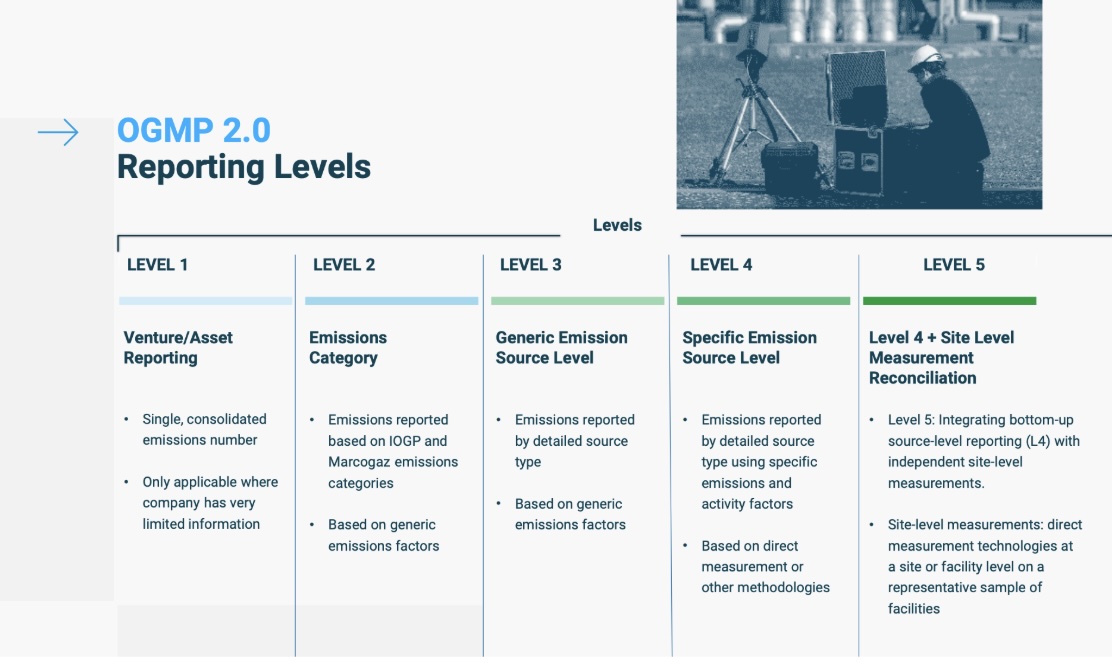
The core goal of the OGMP 2.0 is for all of its partners to achieve the “gold standard” of Level 5 reporting. Under that standard, the company’s portfolio is modeled using emissions factors which are then cross checked with directly measured emissions from a representative sample of sites. Operators are expected to achieve Level 5 reporting across their portfolio within five years of joining the partnership. Operators also have to submit plans for achieving that compliance and submit progress reports. Operators are granted wide discretion in those plans and little information on them is publicly available. Several operators who have already achieved Level 5 reporting have discussed achieving the measurement requirements by conducting fly over surveys of their equipment. In particular, several companies have cited working with a company called Bridger Photonics to achieve Level 5 reporting. In peer reviewed literature, Bridger’s methods have shown significant uncertainty with a paper published in 2022 concluding that over 60% of measurements were off by more than 20%. While that may not appear to be a high absolute uncertainty, methane intensity is often measured on the scale of tenths of a percent where small changes can have a large impact on overall estimation.
This month, OGMP 2.0 published their 2025 progress report on achieving Level 5 reporting. That report concludes that while less than 10% of current production achieves Level 5 reporting, about a third of the global oil and gas supply will be reporting at Level 5 by 2030. The importance of the Level 5 reporting requirements to the EUMR has turned the report into a rorschach test for energy stakeholders. EDF was quick to claim the report “challenges the idea that Europe will struggle to find producers capable of meeting the EU Methane Regulation’s monitoring and reporting requirements.” Simultaneously, the Wood Mackenzie report commissioned by the IOGP argued that while the report showed improvement in achieving Level 5, “incremental progress did not materially change the study’s key findings: significant risk of non-compliant imports persists from 2027 onward”. These two arguments diverge due to assumptions around what oil and gas from the global supply can be sent to the EU as well as how much demand for oil and gas there is in the EU, but this is really a political battle.
I mentioned earlier that some oil and gas companies and the U.S. government are lobbying for the U.S. to be granted country level equivalency so that oil and gas can flow to the EU unimpeded. Both organizations like EDF and IOGP realize that the EU is worried that restricting imports from key countries like the U.S. could endanger its energy security. The Wood Mackenzie report commissioned by IOGP leverages this fear to lobby for granting equivalency to several exporting countries on the basis that many companies will not otherwise be able to comply with the regulations which could halt imports to the EU. This would undermine the regulations by effectively exempting most imported oil and gas from the MRV rules. To push back against the assumption that regulation would undermine the available supply of oil and gas, organizations like EDF are arguing that widespread compliance with the OGMP 2.0 will happen, so the EU will continue to have access to oil and gas even if it does not grant equivalency to the U.S. In effect, the usual political dynamics have been inverted. EDF is touting the sustainability of the oil and gas industry while the oil and gas industry is cautioning that it is much less sustainable than EDF believes.
Both of these stances are a mistake. The OGMP 2.0 has no mechanism to enforce the commitments by operators to achieve Level 5. The 1/3rd of total production projection is based on assuming that an industry known for failed promises and misleading statements will achieve a nonbinding pledge at an unprecedented scale and speed at large cost. For example, the report projects that Qatar will go from 0% of its production at Level 5 to over 90% at Level 5 by 2030 (that projection seems even more unlikely after the recent sustained bombing campaign on Qatari energy assets). As noted by Wood Mackenzie, the progress report also indicates that operators are moving slowly across the levels and may not achieve Level 5 in time. It is likely that less than 1/3rd of production actually achieves Level 5 by 2030.
However, it is a poor solution to these problems to argue that the EU should kneecap its regulations by granting equivalency to countries that everyone knows are not equivalent. The entire concept of the EU methane regulations was to use the large EU market to coerce better behavior from the global oil and gas industry. Assuming a business as usual scenario of OGMP 2.0 uptake undermines that concept. Rather than aiming for the regulations to change industry behavior, the EU risks allowing industry behavior to change its regulations.
The concern about energy security is understandable, but the E.U. has the resources and expertise to join the host of countries rapidly expanding their renewable portfolio. The EUMR does not take full effect until 2030, that is valuable time the EU can and should invest in moving away from LNG and towards renewable energy. Doing so will ensure a secure energy future without compromising our climate to achieve it.
