
Liquid Natural Gas (LNG) export is an extremely expensive undertaking. Price tags on new facilities are in the billions of dollars and it often takes years or even decades before a terminal is profitable. Last month, the Natural Gas Union published their quarterly Gas in Transition magazine discussing the current state of natural gas production and sale. The theme for this issue was “Innovation”. It featured an article by Ian Nathan, the head of LNG and Gas Research for Energy Intelligence (an energy consulting firm), on the new ways that companies are funding LNG projects. Unfortunately, what Ian tries to sell as innovation looks an awful lot like industry panic over banks losing faith in LNG. Even worse, if you have a pension, Ian’s article outlines that there’s a very high likelihood that your pension fund is now taking on the risk that the banks thought was intolerable (I guess gambling with retirement funds is an innovation if you look at it through LNG-tinted goggles).
I’ve been told by my coworkers at Oilfield Witness that explaining this part is boring, but it is important to understand how outlandish Ian’s article is so please bear with me. Since building an LNG terminal is so expensive, most companies that build them have to find financiers to cover some of the cost. Traditionally, this has been through nonrecourse debt. Nonrecourse debt operates differently from the traditional business loan that you are likely thinking of. With nonrecourse debt the energy company comes to an agreement with a lender to fence off the LNG terminal from the rest of their finances. This means the debt is paid off only using cashflow from the LNG terminal. If that revenue is not sufficient to pay off the loan, the company defaults on the debt. To recoup the loan the lender can seize the terminal but cannot seize any of the company’s other assets or collect money from any other part of the company (even if the rest of the company is profitable). In effect, this shifts the risk of building the terminal from the company to the lender.
Imagine I make shoes (I recently watched the Air Jordans movie with Matt Damon so I have shoes on my mind). I am very successful and very profitable. I decide I want to diversify, and the shirt industry is booming. I go to a bank to get a loan to start selling shirts. The bank agrees to finance me with nonrecourse debt. It turns out I am not as good at selling shirts as I am shoes and my shirt business loses money. Because I financed the shirt venture with nonrecourse debt, the bank cannot touch any of the money from the shoe portion of my business. Instead, they’re left holding the bag on my defunct shirt factory while I continue to rake in cash on my Air Jacks. Now imagine that shirt factories also sometimes explode, stopping shirt sales (1,2,3,4). This is effectively the traditional finance model of the LNG industry.
Obviously, this is a risky proposition for banks, so the LNG model relies on financiers having very high confidence in the financial prospects of a proposed terminal. Typically, one of the key considerations in evaluating these projects is the lengthy take-or-pay contracts that LNG terminals sign with LNG buyers. These contracts lock in sales of the terminal’s LNG for decades which creates the stable profit foundation on which bankers rely when agreeing to finance a terminal with nonrecourse debt. However, securing these agreements is time consuming and frequently delays project rollout.
Ian’s article for the Natural Gas Union highlights the shift away from this nonrecourse debt model in U.S. LNG financing towards balance-sheet financing. Rather than agreeing to finance with nonrecourse debt, financiers are increasingly buying equity stakes in the overall companies proposing the LNG terminals. The energy company then uses the money from that equity sale to finance terminal construction directly. Unlike the traditional model which insulates the rest of the company’s balance sheet from a new LNG terminal, this new model weaves the terminal into the company’s overall finances. If the terminal fails, both the energy company and financiers share the risk, and the financiers may still recoup their investment from the rest of the company’s portfolio. As Ian puts it: “Greater reliance on balance-sheet financing (using a mix of internal equity and debt facilities) gives developers more control, even if it carries greater sponsor risk”. Put another way, LNG companies are seeking out new ways to finance terminals that are less risky to lenders by taking on more risk themselves.
Like in many other unfortunate industries, the new kids on the block making these changes happen are private equity firms. Some of them you may have heard of like Blackstone (famous for exacerbating the housing crisis by buying up single family homes) and KKR (the company that killed Toys R Us). Two of Abu Dhabi’s sovereign wealth funds have also been equity buyers in new projects. While it is somewhat ironic to see foreign countries buying stakes in the infrastructure that the Trump administration has called “essential to the national defense”, unfortunately, many of the investors in these projects are actually unsuspecting Americans. Pension managers like Stonepeak are also investing in these new LNG terminals, using people’s retirement funds to finance projects that banks apparently won’t touch.
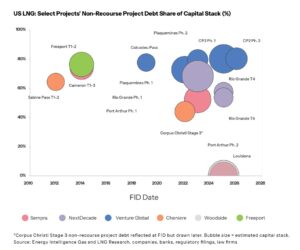 Where historically most projects were financed 60% or more with nonrecourse debt, Ian notes that some recent LNG projects were funded without any. Ian’s take is that equity driven strategies that have replaced nonrecourse debt are an “innovation” “to enhance competitiveness through agility and speed, while smoothing out cyclical volatility”. Setting aside the corporate speak that would make a Mckinsey Consultant blush, Ian’s attitude is that this new financing regime is a good thing for the LNG industry because it gets new LNG terminals fully funded faster.
Unfortunately, for all of the insights into the LNG financing system, Ian seems uninterested in the key question his analysis raises. LNG is experiencing a moment of profound bullishness. There are over two dozen proposed LNG terminals and expansions in the U.S. and the destruction of Qatar’s LNG terminals during the war with Iran has boosted the value of U.S. LNG. The LNG market right now is so strong that when news broke that BP was pursuing a nearly 4 billion dollar judgement against the LNG exporter Venture Global, VG’s share price went up. Trade groups and consultants consistently project huge increases in the LNG market into the 2030s and beyond. If this optimism were mirrored by the banks one would think that this would be a very easy time to secure nonrecourse financing. If energy companies have historically financed terminals with much less risk to themselves why are they suddenly shifting strategies?
It seems obvious that were nonrecourse debt still a viable option, they would be using it, so either the banks don’t want to give the loans or energy companies have run into another problem with nonrecourse debt.
Both appear true but Ian only notes the latter. Ian’s analysis emphasizes that speed has become increasingly important to securing market share in the highly competitive LNG market. This is true, and balance-sheet financing allows facilities to fund faster, which is no surprise given that the company proposing the terminal takes on more risk and self-finances more of the terminal. While Ian does not say this explicitly, it appears that speed is becoming increasingly important because LNG suppliers fear looming oversupply and are trying to lock in sales contracts before that happens.
Ian may not be interested in drawing it out, but the other important consideration is hiding in his analysis. Simply put, it seems like banks are balking at the prospect of more LNG nonrecourse debt financing because they are losing confidence in the long-term LNG export model. The certainty of profit that banks need to accept the risk of nonrecourse debt no longer exists.
Ian flirts with a few reasons. Overzealous demand projections have underestimated renewable energy rollout in some regions, especially in South Asia. The war with Iran, which Ian obliquely refers to as “the Mideast disruption”, has shaken confidence in the reliability of LNG supply. Rising costs and inflation have ballooned the rollout costs for new projects and eaten into LNG sale margins. Ian even acknowledges that LNG “always has been” more expensive than alternative power sources. For more information on these problems, Oilfield Witness’s Justin Mikulka has written extensively about the shaky fundamentals underpinning the LNG market.
Both things are likely true. There is a strategic incentive for LNG companies to bring terminals online quickly which is facilitated with balance sheet financing and banks are less willing than they have been historically to agree to nonrecourse debt. While Ian spins balance sheet financing as an “innovation”, none of this bodes well for the industry and definitely not for the pensioners whose money is funding this “innovation”. Despite flashy projections and the support of the U.S. government, lenders appear to be losing confidence in LNG’s fundamentals and companies know that only the first movers will profit with the coming supply glut.
In the end, one has to ask why? LNG is not the cheapest fuel source. It’s not the cleanest. Banks don’t appear confident that it will be profitable. Why is the energy industry pushing it so hard and why is the Energy Secretary of the U.S. sending open letters to foreign countries threatening them on behalf of the LNG industry? Answering that question in full would require more than a blog post, but one thing is clear; renewable energy is cheaper, cleaner and readily available. It also doesn’t require consultants to try to convince you that losing banker confidence is secretly a good thing.
